IoT Platform Kit
Scalable hardware and software building blocks for connecting devices and linking them to cloud systems: net services, gateways, nodes and wearables – as an add-on module, a hardware design or a pure software stack.
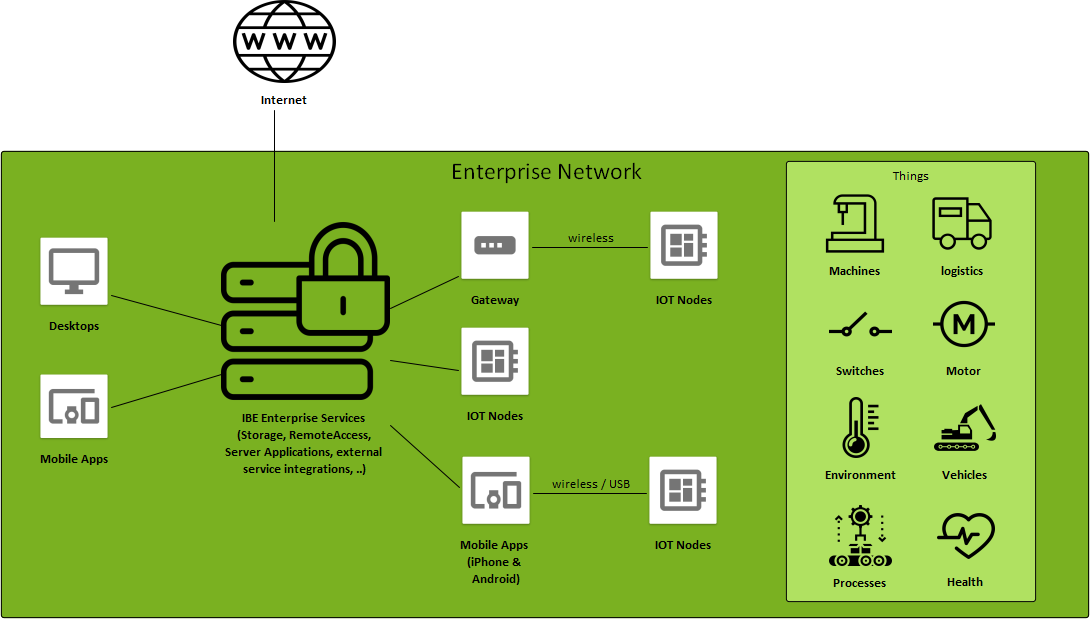
The Internet of Things promises intelligent, connected devices that talk to each other and trigger actions – on the factory floor as much as in the home. But a lot of secondary questions come with it: Can the data be intercepted? Is the system safe against intrusion? Does it fit into existing structures? Where is the data stored?
For many manufacturers this is new territory, and getting up to speed costs time and people – while the market does not wait. That is why we offer a scalable platform you can build your application on, instead of reinventing the wheel. It is also our own proof that we master the entire stack: from the hardware through the firmware to the cloud.
Who the kit is for
- You want to digitalise a product or a process
- You need interoperability across heterogeneous networks
- You want to retrofit devices already in the field
- You need flexible sensors for machine learning or AI applications in places that are hard to reach
- You want to focus on your core competencies and still enter the market quickly and safely
The hardest part is usually the first step – capturing data at the nodes. How is power supplied on site, is autonomous operation required? How is the network connection established, is a gateway needed? What bandwidth, range and energy efficiency are required? For Industrie 4.0: secure exchange following the RAMI 4.0 model with an Asset Administration Shell? The kit answers exactly these questions with proven building blocks.
The four base components
- IoT net services – cloud connection, data storage, interfaces
- IoT gateways – the bridge for nodes that do not speak IP directly; also for retrofitting devices in the field, for IoT and Industrie 4.0 alike
- IoT nodes – the far end of every digitalisation project: sensors and actuators, adapted to the application
- IoT wearables and smartphone extensions – support for staff working on the move
The layer model
The layer model covers nearly every application scenario; the middleware provides all the interfaces you need. You are free to choose the network interface (Wi-Fi, Bluetooth, NFC, Ethernet, powerline and others) and to implement the system on the target of your choice – which is what makes a clean fit into existing systems possible.
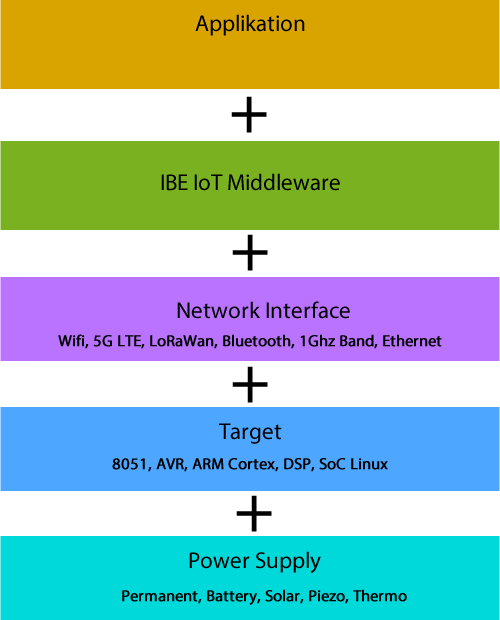
- Application layer – your specific implementation
- IBE IoT middleware – fast, secure application development, prepared sensor data, simple access to interfaces
- Network interfaces – fieldbus interfaces, radio technologies chosen for bandwidth, range and energy efficiency
- Target – processing power and power budget to match the application (8051, ARM, x86 and others)
- Power supply – mains, battery or energy harvesting (solar, piezo, thermal)
Three ways to integrate
Which one fits depends on how far your product already is:
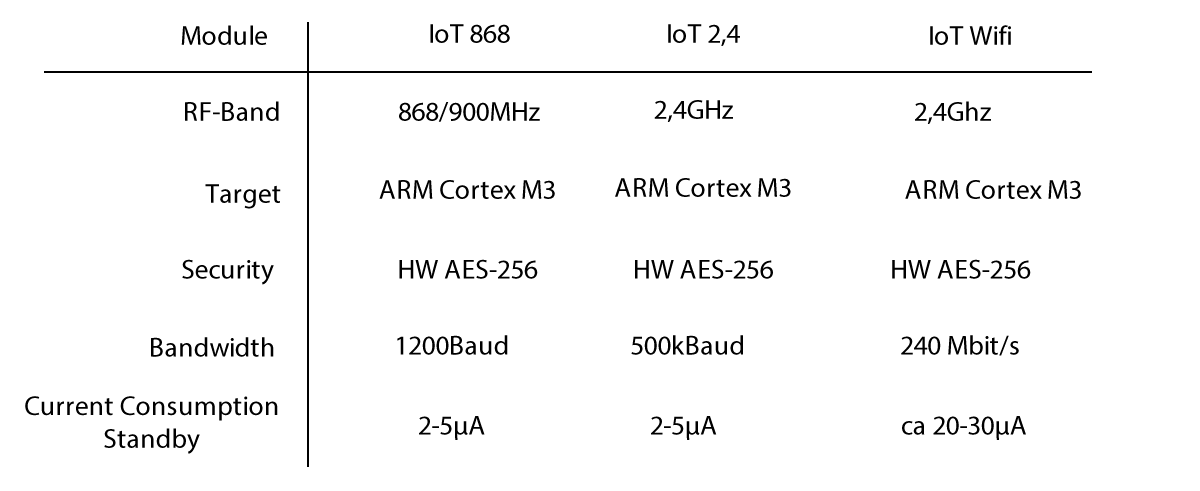
As an add-on module – use one of our modules and extend your device with IoT services. The fastest way to connect a device.

As a hardware design – we help you integrate our hardware concept directly into your product, so that all software components keep working exactly as intended inside your device.

As a software stack – you already have hardware with communication capability? Then integrate our software stack and benefit from a stable, secure connection.

Advantages
- Fast and dependable integration
- Data security through built-in encryption
- Ideally no changes to your existing product
- Cost-effective thanks to a scalable approach
- Low power consumption for battery-powered applications
- From roughly 50 nodes onwards, a customised variant from our building blocks becomes worthwhile
Would you like advice or a quotation for the IoT Platform Kit? Get in touch.